Vocal range chart
Six voice types, bass to soprano, on one piano keyboard. Each bar runs from the lowest to the highest note a music dictionary gives for that voice, with both notes in hertz.
Updated
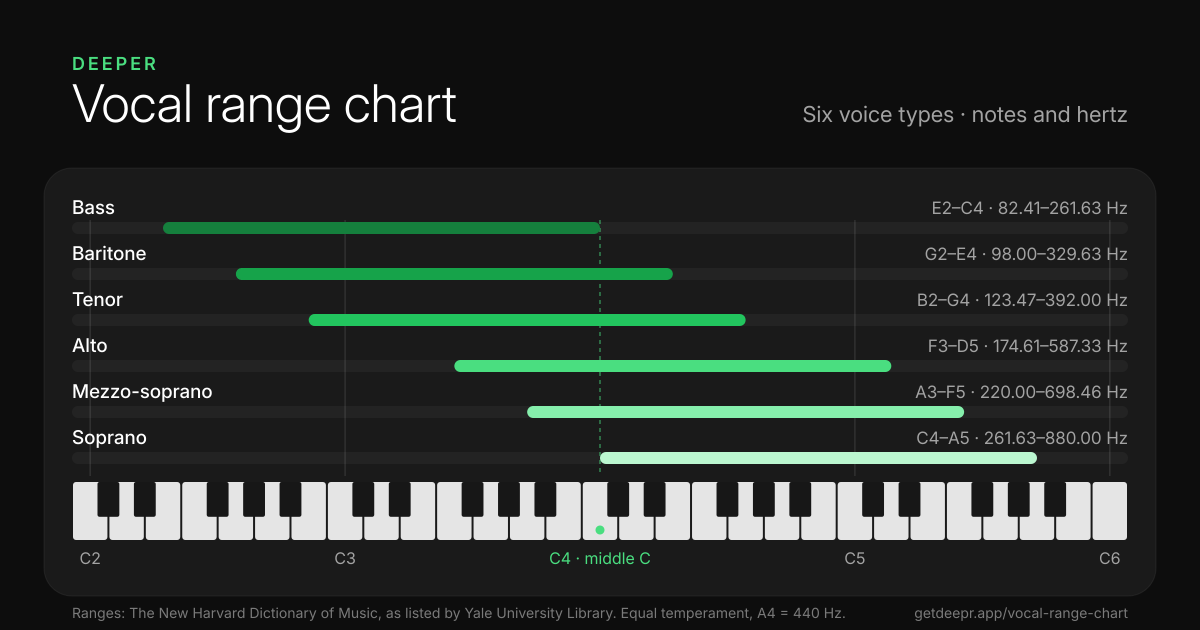
Hover, focus or tap a voice type to light up its notes on the keyboard.
Vocal ranges from lowest to highest
The same six vocal ranges as a table, lowest voice first. The notes are the ones The New Harvard Dictionary of Music lists for each voice type. The hertz are calculated from the note names with A4 tuned to 440 Hz, so they are exact for those notes, rounded to two decimals.
Male vocal range chart
Bass, baritone and tenor are the male voices, lowest to highest, as Britannica describes them. Together they run from E2 to G4 in this list.
Hover, focus or tap a voice type to light up its notes on the keyboard.
Bass vocal range
The bass vocal range runs from E2 (82.41 Hz) to C4 (261.63 Hz), middle C. Britannica calls the bass “the lowest male voice.”
Example: Britannica describes Feodor Chaliapin as “a Russian operatic basso profundo.”
Baritone vocal range
The baritone vocal range runs from G2 (98.00 Hz) to E4 (329.63 Hz). Britannica calls the baritone “the most common category of male voice, between the bass and the tenor and with some characteristics of both.” Britannica’s entry puts baritone parts slightly higher, from A2 to F4, which shows how references drift by a note or two.
Example: Britannica describes Dietrich Fischer-Dieskau as “a German operatic baritone.”
Tenor vocal range
The tenor vocal range runs from B2 (123.47 Hz) to G4 (392.00 Hz). Britannica gives the same two notes for the “highest male vocal range” and adds that a tenor’s range “may extend slightly lower or higher.”
Example: Britannica describes Luciano Pavarotti as “an Italian operatic lyric tenor.”
Countertenor is not on the chart. Britannica’s tenor entry gives that name to “an extremely high voice, extending into the alto range,” but neither reference used here lists its notes, so this page does not draw a bar for it.
Female vocal range chart
Alto, mezzo-soprano and soprano are the three higher voices, running from F3 to A5 in this list. Britannica notes that soprano “generally refers to female voices,” though the word is also used for boy sopranos.
Hover, focus or tap a voice type to light up its notes on the keyboard.
Alto vocal range (contralto)
The alto vocal range runs from F3 (174.61 Hz) to D5 (587.33 Hz). Britannica gives the same notes, calls the alto “the second highest part in four-part music,” and treats contralto as the same voice: “also called alto.”
Example: Britannica describes Kathleen Ferrier as “a contralto.”
Mezzo-soprano vocal range
The mezzo-soprano vocal range runs from A3 (220.00 Hz) to F5 (698.46 Hz). Britannica places the mezzo-soprano “between the soprano and the alto,” with the same low note and a top of “the second F or G above middle C.”
Example: Britannica describes Cecilia Bartoli as “an Italian operatic mezzo-soprano.”
Soprano vocal range
The soprano vocal range runs from C4 (261.63 Hz), middle C, to A5 (880.00 Hz). Britannica gives the same range, “from middle C to the second A above,” and calls the soprano “the highest human vocal register.”
Example: Britannica describes Leontyne Price as “an American lyric soprano.”
Range vs tessitura: why charts overlap
A vocal range is the span from the lowest note to the highest. Tessitura is a different idea. Britannica defines it as “the general range of pitches found in a melody or vocal part,” set by “which part of the range is most consistently used” rather than by a few isolated high or low notes. Two voices can share most of their notes and still spend most of their time in different places.
That is why the bars overlap. Bass and baritone share G2 to C4, 17 of the bass’s 20 semitones, and every pair of neighbouring voice types in this list shares at least 14 semitones, more than an octave.
References also disagree by a note or two. Grove Music Online, quoted on the same Yale page, puts the tenor at “roughly C3 to A4” and the baritone at A2 to F4, and Yale adds that “vocal ranges for solo or choral works may differ.” This page takes every bar from one reference so the bars compare with each other. Read the ends as typical, not as limits.
Where your speaking voice sits on the chart
The chart above is about singing, but a speaking voice has a pitch too, and it goes on the same keyboard. The voice Hz test sorts speaking pitch into five bands. The one it calls average runs 115–135 Hz, about A♯2 to C♯3, for men, and 185–215 Hz, about F♯3 to A3, for women. Those bands are the site’s rule of thumb, not cutoffs from a study, and they say nothing about anyone’s gender.
On this keyboard the men’s band falls in the lowest few notes of the baritone range and around the tenor’s lowest note, B2. The women’s band sits at the bottom of the alto range, just under the lowest note of the mezzo-soprano, A3.
Hover, focus or tap a voice type to light up its notes on the keyboard.
To put your own speaking pitch on it, take the voice Hz test or watch your pitch move live on the voice pitch analyzer. The deep voice test turns the same number into a verdict in words.
Your range
Find your place on the chart
The vocal range test listens while you hold a low note, glide up and hold a high note, then names both ends as notes and in hertz. Lay those two notes over the bars above to see which ranges they overlap.
Take the vocal range testSources
Ranges vary by source and by context. A choral part, a solo role and one singer’s voice are three different things, and references draw the lines a note or two apart. This page uses one reference for every bar so the bars compare with each other.
- The New Harvard Dictionary of Music (Harvard University Press, 1986): the ranges in the chart and the table, as listed by Yale University Library, Music Cataloging at Yale, “Vocal Ranges.” The same page quotes Grove Music Online’s ranges, used above for comparison, and the convention that C4 is middle C. Yale University Library: Vocal Ranges
- Encyclopaedia Britannica: the descriptions of each voice type, the baritone’s written range, the countertenor and tessitura, and the singer examples. bass, baritone, tenor, alto, contralto, mezzo-soprano, soprano, tessitura.
- National Association of Teachers of Singing, Science-Informed Voice Pedagogy Resource, “Terminology and Definitions for Science-Informed Voice Pedagogy” (final version, June 25, 2022), entry “Fach.” Quoted in the voice-type answer.
- Hertz: calculated from the note names in equal temperament with A4 = 440 Hz. A definition, not a measurement. The speaking bands are the voice Hz test’s own scale.
FAQ
Vocal range questions
What is a normal singing vocal range?
There is no single normal range for everyone. What a reference gives is the range of each voice type. In The New Harvard Dictionary of Music, as listed by Yale University Library, each of the six spans 20 or 21 semitones, a little more than an octave and a half, from E2 to C4 for a bass up to C4 to A5 for a soprano. Yale adds that ranges for solo or choral works may differ. To measure your own, use the vocal range test.
Where is the soprano range?
From middle C, C4 (261.63 Hz), up to A5 (880.00 Hz), the second A above middle C. It is the highest of the six bars on the chart. Britannica gives the same range.
Is E5 a high note for females?
It depends on the voice. E5 (659.26 Hz) is above the top of the alto range on this chart (D5), close to the top of the mezzo-soprano range (F5), and in the upper part of the soprano range, which runs to A5.
Is G5 high for a guy?
By this chart’s ranges, yes. G5 (783.99 Hz) is a full octave above G4, the top of the tenor range, which is the highest male range in the list this page uses. It is also above the top of the alto range, D5.
What are the highest and lowest voice types?
The soprano is the highest: Britannica calls it “the highest human vocal register,” and on this chart it tops out at A5. The bass is the lowest: “the lowest male voice,” starting at E2 (82.41 Hz).
What is the rarest vocal type?
We found no ranking of voice types by rarity in the references this page uses, so this page does not name a rarest one. Britannica does name the most common male voice: the baritone.
What is middle C?
Middle C is C4 (261.63 Hz), with A4 tuned to 440 Hz. The note names on this page follow the ISO system, which, as Yale’s page puts it, “assigns ‘C4’ to middle C.” A British convention calls the same note c1. On the chart it is the key with the green dot.
How do I tell my voice type?
Range is only part of it. The National Association of Teachers of Singing describes Fach, the detailed system of voice categories, as determined by “the tessitura capacity and timbre of a voice,” and neither shows up in two note names. Your lowest and highest notes can tell you which bars on this chart they overlap. A voice teacher who hears you sing is the way to a voice type.
Does head voice or falsetto count in your vocal range?
The chart cannot settle that, because its ranges are a reference’s ranges for each voice type, not a measurement of any one singer, and the list does not say how a note is produced. When you measure your own range, decide before you start whether you are counting falsetto and keep to it from one take to the next, so the numbers compare. The vocal range test reports any note you hold steadily.
More tools
Other ways to measure your voice
Vocal range test
Find your lowest and highest note, then place them on this chart.
Voice Hz test
Your speaking pitch as one number.
Voice pitch analyzer
Pitch and note name, live, while you speak or sing.
Deep voice test
A verdict on how deep your speaking voice is.
Pitch detector
Sing any note on this chart and see its name and hertz, live.
Read next
How Your Voice Works: The Science of Speaking
Your voice starts with breath, vibrates through tissue thinner than skin, and exits reshaped by your throat and mouth. Here's the fascinating science.
Know where voices sit. Train yours.
Deeper scores your speaking voice each day and gives you exercises in between. This chart shows where the voice types sit. The app is where you work on the voice you use.